Most people searching "low risk casino" land on a page that assumes they already know what one is. That is not a great introduction. Risk-free and low-risk are two distinct categories of casino offer, they work differently, and the order you run them in actually matters when you are starting out.
This article does the comparison plainly. What each type is. How the mechanics differ. Why beginners are better starting with risk-free to learn the ropes, before progressing to low-risk to elevate their earnings. And the simple path from "I have no idea what I am doing" to "I am tracking real profit across multiple operators".
The short answer
Start with risk-free. Graduate to low-risk.
Risk-free offers let you learn how the offers work, how you interact with slots, and what the terms actually mean. No money at risk. The education is excellent and you cannot lose.
Low-risk offers have expected value once you know what you are doing, but you put real money on the line. Run a few risk-free offers first, build confidence, then move across.
What a risk-free offer actually is
A risk-free offer is a promotion where you cannot lose money. This usually comes as free spins, where the casino funds the spins and you keep any winnings. Sometimes it involves a deposit, but you do not have to spend it. You get the free spins regardless, and you keep what you win from them.
Risk-free offers have positive expected value because your downside is zero. You cannot lose capital. Your winnings from the free spins are yours to keep or withdraw.
Examples of what risk-free offers look like in practice: 20 free spins on a named game, you keep what you win. Or a deposit offer where you deposit £10 (which stays in your account) and get 50 free spins. You keep any winnings from the spins. The risk-free offers list ranks the current UK options by expected value.
What a low-risk offer actually is
A low-risk offer requires a deposit, usually £10 to £30. You wager through your deposit once, and once you have met that requirement, you unlock a set of free spins. You then keep whatever you win from those free spins as cash. There is real capital at stake during the wagering. If you lose some of your deposit during that process, you lose the money. But the expected value of the offer is still positive, meaning on average across many offers you should come out ahead.
The key difference from risk-free is that your deposit is at risk during the wagering phase. You have to spend it to unlock the free spins. But the free spins themselves are where the profit opportunity lives, and those winnings are yours to keep. The Academy walkthrough goes through how to calculate expected value and manage your bankroll.
Side by side
The differences that actually matter when you are choosing where to start.
| Factor | Risk-Free Offer | Low-Risk Offer |
|---|---|---|
| Deposit required | Sometimes (free spins or deposit with refund) | Yes (usually £10 to £30) |
| What you play with | Free spins or deposit (if offered) | Your deposit plus any bonus |
| Capital at risk | Zero (spins are free or deposit protected) | Your deposit (real money at stake) |
| Outcome variance | You win small, break even, or get your deposit back | You can actually lose money, but edge is positive |
| Best for | Getting the gist without risk | Building real income through volume |
The pattern in that table is the whole article in miniature. Risk-free offers are pedagogically perfect (no money to lose, real mechanics to learn) but the expected value is modest. Low-risk offers pay better but assume you already know what you are doing.
Why beginners should start with risk-free
Three reasons, in the order I think about them.
You learn how slots actually work
Risk-free offers teach you the basics: how slot machines work, how free spins function, what RTP means, how variance shows up in real play, which games qualify. All of this matters once you graduate to low-risk. Learning it without capital at risk is dramatically easier than learning it with money on the line.
You build a feel for variance before it costs you
One of the hardest things to internalise about positive-EV casino play is that the expected value is real across many offers, not guaranteed on any single one. Slots are high-variance. A £10 bonus session can go to zero in eight minutes, or it can run to £80. Watching that happen a few times on the casino's money is the most efficient way to develop the right mental model. People who go straight to low-risk often quit after one or two losing offers because they read the expected value as a promise, not an average.
You build the habit of reading terms carefully
Every casino offer lives or dies in the small print. Maximum bet during wagering. Game weighting. Excluded slots. Withdrawal caps. Time limits. The habit of skim-reading the offer terms before you click "claim" is the single most valuable skill in this whole thing, and it costs nothing to develop on risk-free offers.
The expected value is real across many offers, not guaranteed on any single one. The sooner you internalise that, the easier the psychology is to deal with.
Why you move to low-risk once you are ready
You move to low-risk when three things are true. You understand how slots and casino mechanics actually work. You have internalised what expected value means across a sample size, not on any single offer. And you are mentally prepared to handle losing your deposit on some offers, even though the edge is positive across many.
But you now have real capital at stake. Mistakes cost money. Forgetting to check the max bet during wagering on a low-risk offer can void your bonus and your deposit is lost. This is why the order matters. You want the small-print discipline and the mental model of variance already in place before you play with money you could actually lose.
The honest part: variance is wider too. Most low-risk sessions land near expected value, but some end with you losing the full deposit and some end with a slot win that pushes you well above expected value. Across 30-50 offers, the average should align closer to where the maths says it should. On any single one, anything can happen. Doing the volume is part of the strategy, not optional.
When you are evaluating a specific offer to decide whether to run it, the low-risk EV calculator takes the deposit, bonus, wagering requirement, and slot RTP and tells you the expected value in pounds. It is the same calculation I use before claiming anything myself.
See what the EV calculator looks like
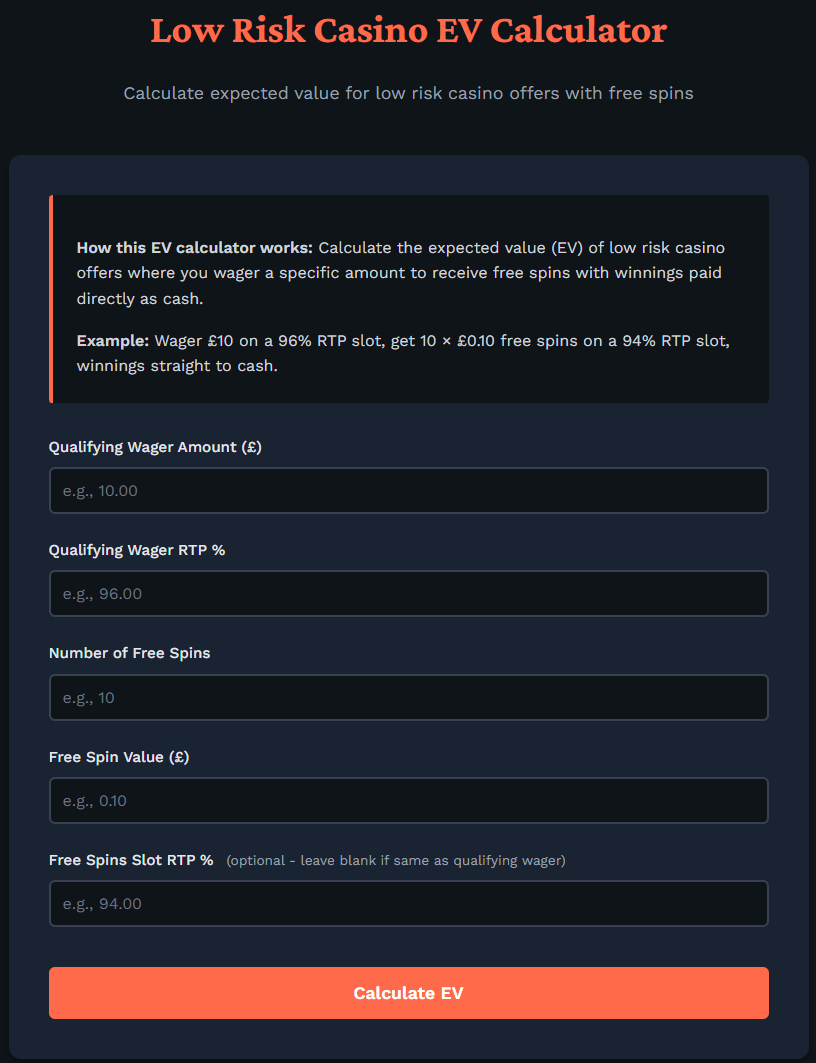
The calculator plugs in your offer details and returns the expected profit in pounds. Takes about 90 seconds per offer.
The actual path from beginner to confident
If I were writing a four-step plan for someone who has just discovered all this exists, it would look like this.
Read one foundational article
Start with Understanding Expected Value. Ten minutes of reading saves you from running offers with negative EV and not realising it.
Run a few risk-free offers
Work through the risk-free list at whatever pace suits you. You are not optimising for income at this stage, you are optimising for understanding. Get a feel for how the offers work, how you interact with the slots, what the terms actually mean when you are playing. Three to five is enough to get the gist of things.
Graduate to low-risk with a sensible bankroll
£100 is enough to cycle through several low-risk offers without ever having more than one deposit exposed at a time. Use the EV calculator before each offer. Stick to high-RTP qualifying slots.
Track everything
Logging your offers as you go is what turns "I think this is working" into "I can see this is working". The profit tracker lets you log each offer and compare expected value against actual profit over time. The actual line will wobble around the EV line. Both rising together.
The whole sequence takes most people somewhere between four and eight weeks at a comfortable pace, and that is fine. There is no prize for rushing.
One more thing on tracking
The hardest stretch when you start running low-risk offers is the first ten or so. Variance has not had time to average out, so your actual results can be well above or well below expected value. Without a record of what you expected to make versus what you actually made, it is very easy to talk yourself into stopping after a couple of losing offers.
A simple log of every offer, with the expected value and the actual outcome, fixes this. You see the variance, you see the EV holding steady underneath it, and over enough offers the two lines converge. Whether you use a spreadsheet or the built-in profit tracker, the discipline of logging is what keeps people in the game long enough to actually see the maths work.
See what profit tracking looks like in action
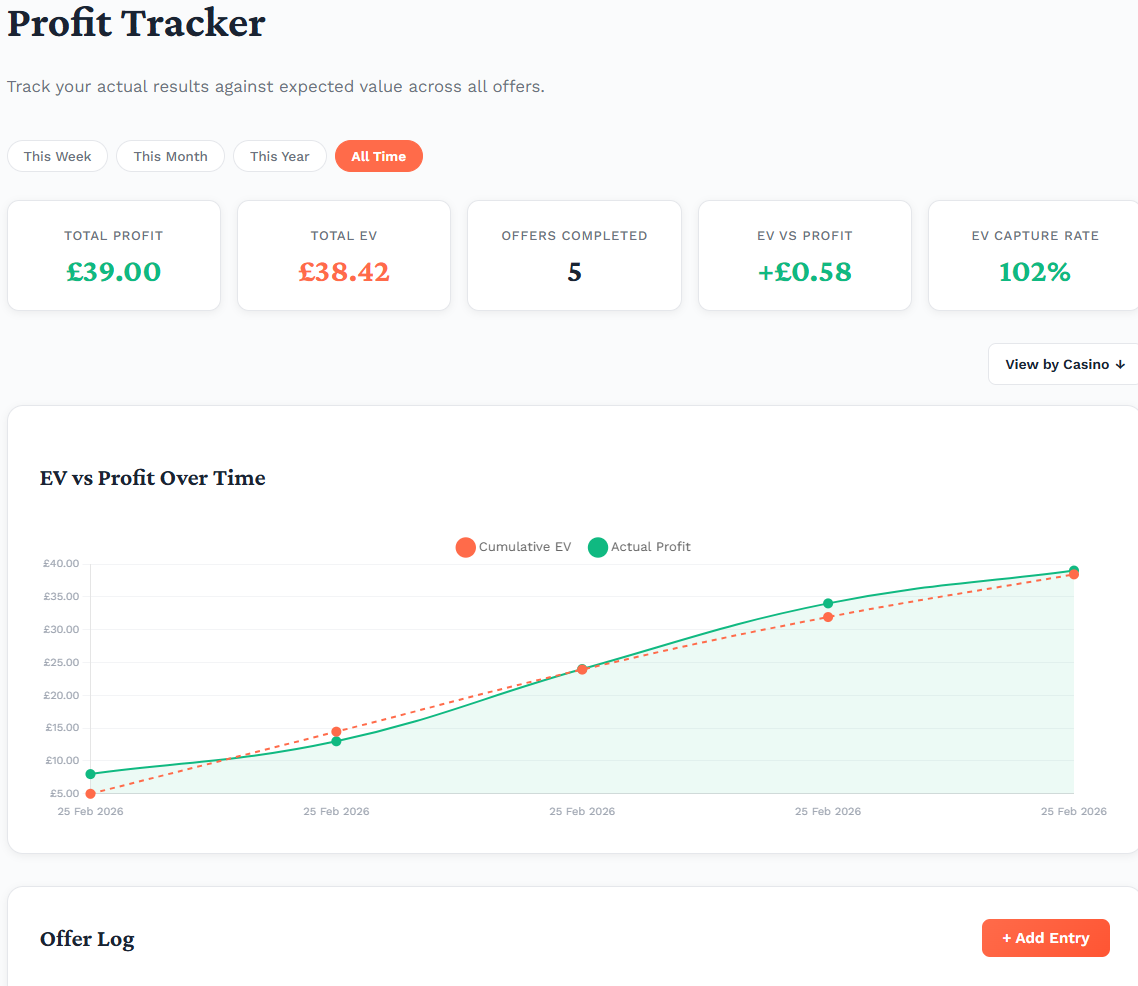
Notice the two lines (EV and actual profit) running nearly parallel. That is what you are looking for. The variance wobbles around the expected value line, but the direction is consistently up.
FAQ
What is the difference between a risk-free and a low-risk casino offer?
A risk-free offer gives you free spins or a protected deposit. Either way, you cannot lose money. You play, you either win a small amount or get your stake back. A low-risk offer requires you to deposit real money with no protection. If you lose, you lose the deposit. But the expected value is positive across many offers, and usually higher than risk-free offers, so volume pays off.
Which type of casino offer should beginners start with?
Start with risk-free offers. They let you see how the offers work, interact with the platform, and understand the terms without any downside. Once you have run a few and feel confident with the mechanics, move on to low-risk offers, which pay better expected value but do involve real capital risk. Getting a few under your belt first makes the jump less daunting.
Why don't more people profit on risk-free offers?
The expected value is typically small (£1 to £5) because you are working with a small deposit over a short wagering requirement. Variance means most individual sessions end near zero profit or close to breakeven. You either get a small win or a refund. The expected value across many offers shows up in volume, not on any single offer. The profit rate is still positive because you cannot lose money, but the average profit per offer is modest.
Do low-risk casino offers have better expected value than risk-free?
Yes. Risk-free offers typically sit in the £2 to £8 expected value range because the deposits are small and the wagering requirements are tight. Low-risk offers usually sit in the £5 to £20 expected value range because you get a larger bonus matched to your deposit, giving more spread between the bonus value and the expected loss. The trade-off is that low-risk offers involve real capital at risk, whereas risk-free deposits are protected.
Can I do risk-free and low-risk offers at the same time?
Yes, and most people eventually do. The two categories sit on different operators most of the time, so they do not cannibalise each other. The reason the beginner path runs risk-free first is purely about learning safely with no capital exposure, not because the two methods cannot coexist.
How much can I realistically expect to make as a beginner?
Running the current UK risk-free offers end to end usually adds up to somewhere in the £20 to £60 of expected value range, spread across maybe fifteen offers with modest expected value on each one. Once you graduate to low-risk, the full set of UK welcome offers represents a few hundred pounds of expected value across all licensed operators. After welcomes, ongoing reload and daily free offers can produce £100 to £400 a month for someone running them consistently. None of this is guaranteed on any individual offer.
Where to start today
If you take one thing from this article, it is the order. Risk-free first to learn. Low-risk after to earn. The two categories of offer are complementary, not competing, and almost everyone running casino offers seriously ends up working through both.
The risk-free offers list is where the path begins. Pick one, read the terms, claim the bonus, run the wagering, see what happens. By the time you have done ten of them, you will know whether this is for you and you will have learned every concept you need to move across to the low-risk list with your eyes open.