When you are doing offers, your sense of how things are going is unreliable. Tracking replaces that gut feeling with actual numbers. It tells you how many offers you have done, what your profit looks like against expected value, where your money is sitting across different casinos, and enough detail to understand your own performance over time.
Five fields per offer. One page for the big picture.
Log the casino, what you deposited, the expected value, the actual result, and where the money is now. The profit tracker handles this on every offer page and keeps a running total. The profit dashboard is where you step back and read the trend.
None of this is about whether you should keep going or stop. It is about knowing what is actually happening with your money.
Your brain is bad at this job
Human memory is terrible at keeping an honest scoreboard. We remember the offer that went sideways far more vividly than the five that came in as expected. That is loss aversion - a loss stings roughly twice as hard as an equivalent gain feels good.
When you try to recall how things are going, the bad results get more weight than they deserve. An offer busts before it qualifies and your brain quietly files the whole project under "this is not working." The wins fade out because nothing about them demanded your attention.
Variance amplifies this for deposit offers. Each one carries positive expected value, but any individual result can go against you - and four losses in a row feel like evidence the approach is broken, when in reality that is well within normal. Your gut reads it as failure. The numbers read it as statistics.
A record fixes this. When you can look at the actual count and actual total, the noise stops driving the story. The offer simulator is worth running once just to see how widely results scatter before they settle - a five-offer losing streak becomes a lot less alarming when you have watched it happen a hundred times in simulation.
What to track (and what it tells you)
When you are doing a few offers a week, you can probably hold the details in your head. Once that volume picks up, mental tracking collapses. You cannot remember which casinos have a balance sitting in them, what you deposited where, or whether last week was actually up or just felt that way. At that pace the gaps in your memory are not small errors. They are entire balances you have forgotten about.
For each offer, five fields cover everything useful.
- The casino and the offer. Which brand, which specific offer.
- What you deposited. Your actual stake.
- The expected value. What the offer was theoretically worth before you played. The low risk EV calculator works this out in under a minute.
- What you actually got back. The real result, win or lose.
- Where the money is now. Withdrawn, pending, or still sitting in the casino balance.
See what the log offer form looks like
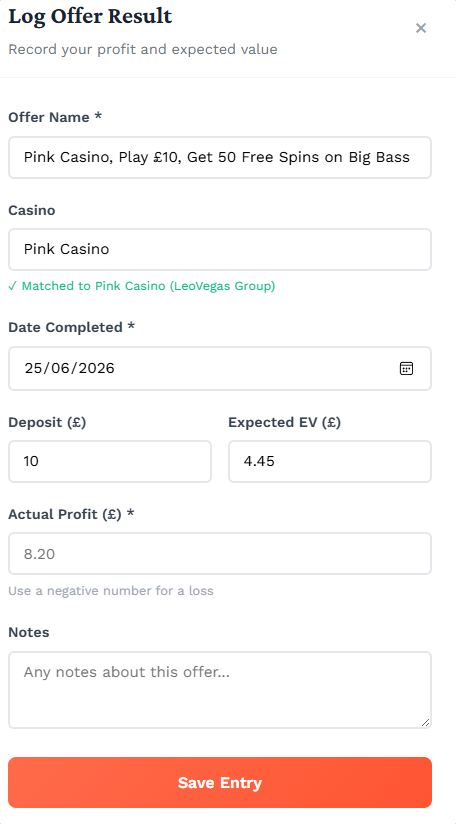
The form is embedded on every offer page on the site. Casino names are matched to their group automatically, so filtering by family works without any extra steps.
The profit tracker is built around exactly these fields and is embedded on every offer page, so you can log the moment you finish rather than trying to remember later.
The casino vault is a separate feature alongside the per-offer log. When you are running multiple offers, cash gets scattered across balances, pending withdrawals, and deposits at casinos you finished with weeks ago. The vault is where you record how much you are holding at each casino, so you can see where your money sits at a glance instead of logging into every account to add it up.
See the casino vault

Each row is a casino you have active money at. Profit updates as you log offers. The group column helps you keep track of sister brands within the same operator family.
Once these are logged consistently, the numbers answer the questions that matter: how many offers you have done, what your profit looks like against your combined expected value, and whether you are tracking near where the maths predicted or have a gap worth investigating. (If the idea of expected value is new, the academy covers it properly.)
For the bigger picture, the profit dashboard is a separate page that pulls your full history into one view. The tracker is where you log day-to-day; the dashboard is where you step back and read the trend. If you are completely new to this, start with your first casino offer and log it the moment you finish.
What the premium tier adds
The free tier covers the basics on its own. You can log offers and see your last five entries, vault up to five casinos, and watch your running profit total build. For someone doing offers casually, that is plenty.
The premium tier is for people whose volume has outgrown the free limits. It opens up:
- Full offer history. Unlimited entries instead of just your last five, so nothing falls off the bottom.
- Unlimited casino vaults. Track balances across as many casinos as you actually use, not a capped five.
- The full profit dashboard. Filterable by date range, showing your EV capture rate, top and bottom performing offers, and pattern and trend data over time. It is the difference between knowing your total and understanding your performance.
See the EV vs profit chart
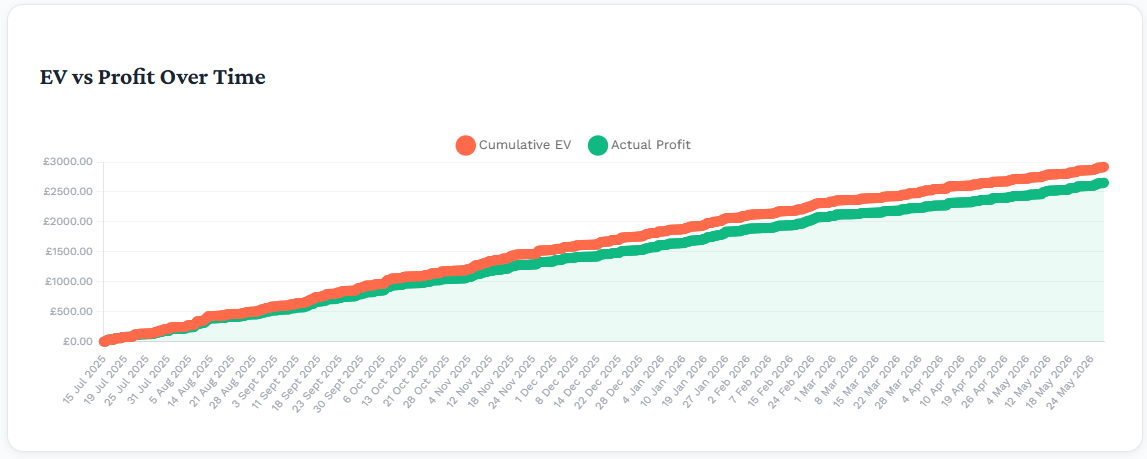
The orange line is cumulative expected value. The green line is actual profit. Both trending upward together is what you are looking for. The gap between them narrows as variance evens out over more offers.
That chart is the feature that earns its place once you have real volume behind you. Seeing your profit line track alongside your expected value line, over dozens of offers, tells you in one glance what no individual result can.
A worked example
Say you run eight offers over a couple of days. Here is roughly how they might land.
| Offer | Expected EV | Actual result |
|---|---|---|
| Offer 1 | +£6 | +£14 |
| Offer 2 | +£14 | -£14 (bust) |
| Offer 3 | +£5 | +£5 |
| Offer 4 | +£18 | +£32 |
| Offer 5 | +£8 | -£8 (bust) |
| Offer 6 | +£11 | +£42 |
| Offer 7 | +£7 | +£6 |
| Offer 8 | +£16 | +£9 |
| Total | +£85 | +£86 |
Two of the eight lost money, and if you only remembered those two you would swear the whole thing was a waste. But the record shows you finished fractionally above your combined expected value, with the losers comfortably absorbed by the winners.
Without a record, offers 2 and 5 dominate the memory. With one, you can see that variance behaved exactly as expected and the total landed where the maths said it would. Run the same eight offers again and the individual results would scatter differently, but the total would tend back toward that expected value line. The offer simulator lets you watch that happen directly.
Each offer adds a point. The two lines - expected value and actual profit - run roughly parallel as variance does its thing. Over enough offers, the gap between them closes. That picture is only visible if you are logging.
A quick note on tax
In the UK, gambling winnings are not taxed for the individual player. There is no tax return to file on offer profit.
FAQ
How do I track casino offer profit in the UK?
Record each offer as you complete it: the casino, what you deposited, the expected value, what you actually got back, and where the money is now. The profit tracker on this site is built around those exact fields and keeps a running total for you.
What is the difference between profit and EV when doing casino offers?
Expected value (EV) is what an offer was theoretically worth before you played it. Profit is what you actually banked. Over a small number of offers the two can differ a lot because of variance, but over many offers your profit should tend toward your combined expected value.
Is there a free casino offer profit tracker?
Yes. The free tier of the profit tracker lets you log offers and see your last five entries, vault up to five casinos, and watch a running profit total. The premium tier adds unlimited history, unlimited vaults, and an EV vs profit chart.
What is the casino vault feature?
The casino vault is a way to record how much money you are holding at each casino, so you can see where all your cash is sitting at a glance instead of logging into every account. The free tier covers five casinos; the premium tier is unlimited.
Why does my casino offer profit look worse than expected?
Usually variance. A short run of offers can sit well below its expected value purely by chance, and your memory makes the losses feel heavier than they are. Tracking against EV tells you whether you are actually running below the maths or just inside a normal rough patch. The offer simulator shows how wide that normal scatter can be.
Do I pay tax on casino offer winnings in the UK?
No. Gambling winnings are not taxed for individual players in the UK.
When should I start using a profit dashboard?
As soon as your volume picks up. Once you are doing many offers a week, the profit dashboard is the only practical way to see your trend and overall position, rather than reacting to individual results.